
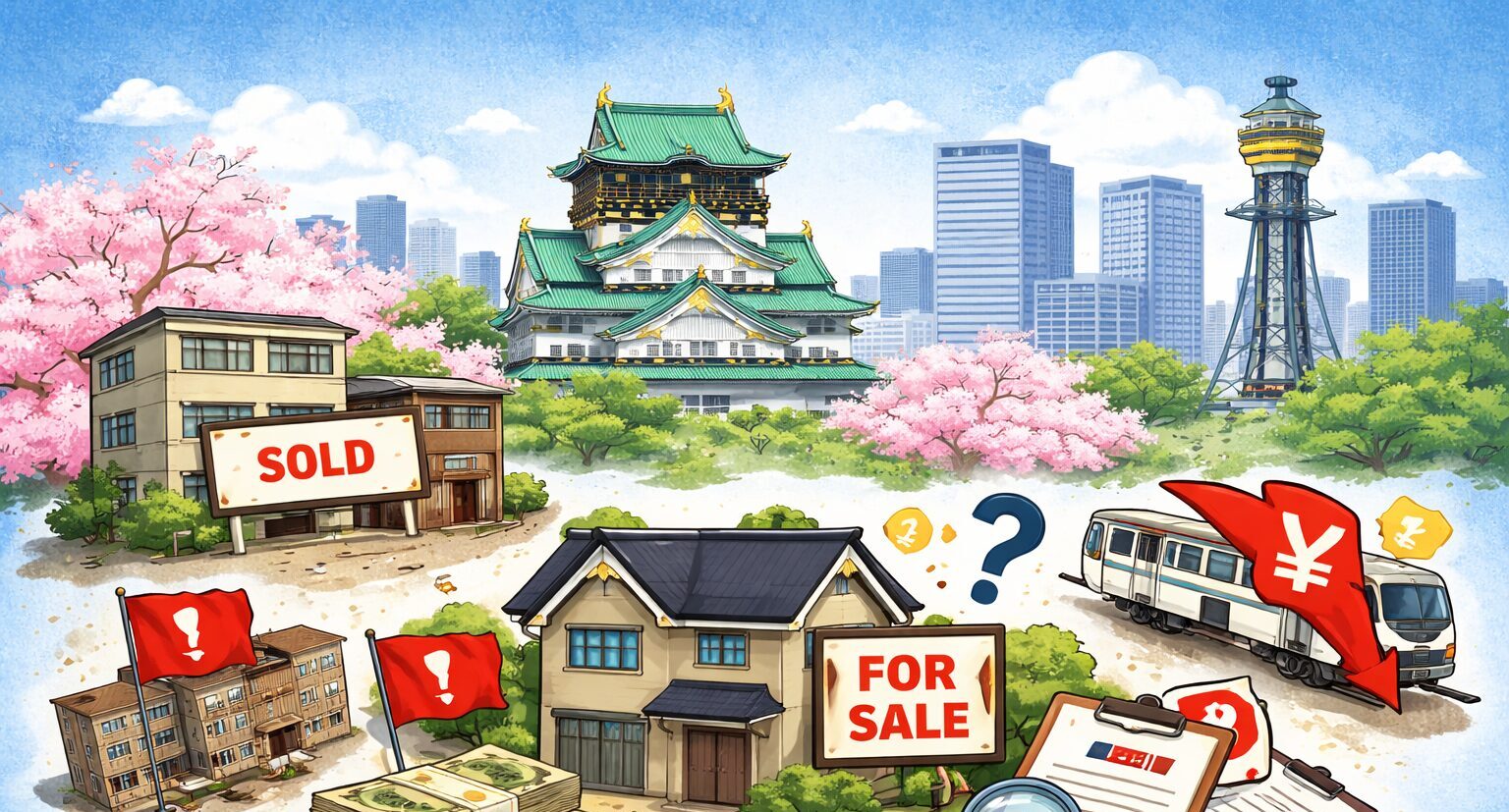
Japan is one of the few developed countries in the world where foreigners can own real estate with almost no restrictions. No special visa, no residency requirement — just sign the papers and the house is yours. For many, this is irresistible. And for many, it becomes the most expensive lesson of their lives.
Falling in Love with an Akiya — Without Reading the Fine Print
The dream: a charming old farmhouse in the Japanese countryside for ¥500,000. The reality: ¥8 million in mandatory renovation costs, a septic tank condemned by the municipality, and a roof held together by optimism and old nails.
Japan’s famous akiya (vacant house) listings have captivated foreign buyers for years. The prices look impossibly good — because they often are. Many akiya are listed cheap precisely because the sellers know what lurks inside the walls: rot, asbestos, unregistered additions, or foundations that have quietly been sinking since the Showa era.
Some akiya are listed by municipalities as “gifts” — free to take. But accepting them means inheriting all future liabilities, including demolition costs that can exceed ¥3 million if the structure is deemed unsafe.
Always commission a full building inspection (homu inspekushon) before signing. Budget at least ¥50,000–¥80,000 for the survey. It’s cheap insurance against a money pit.
Trusting Google Translate for the Jūyō Jikō Setsumei-sho
Every real estate transaction in Japan requires a document called the Jūyō Jikō Setsumei-sho — the Important Matter Explanation. It is read aloud by a licensed takken agent at signing and runs anywhere from 10 to 40 pages of dense legal and technical Japanese.
This document contains everything that could materially affect your decision: whether the land is in a flood zone, whether there’s a right-of-way crossing the property, whether a neighbor holds easement rights, whether the building was built before 1981 (pre-earthquake-code), and dozens of other critical disclosures.
Many foreign buyers nod politely through the entire reading, understanding perhaps 20% — then are shocked years later to discover the land cannot be subdivided, or the road frontage is legally insufficient to build a new structure.
Request the document in advance and hire a bilingual real estate attorney or buyer’s agent to translate and explain every clause before the signing day. Do not treat signing day as the time to learn what you’re buying.
Ignoring Kanri-hi and the Hidden Costs of Condominium Life
A sleek Tokyo apartment listed at ¥45 million seems reasonable — until you factor in the monthly management fee (kanri-hi), repair reserve fund (shūzen tsumitate-kin), parking fees, and fixed utility charges. Some older buildings levy special assessments of ¥1–3 million per unit for major repairs, with no warning and no opt-out.
One buyer in Shibuya purchased a unit, only to receive a special assessment notice six months later for elevator replacement — a ¥800,000 bill she had no idea was coming.
Ask for the building’s chōki shūzen keikaku (long-term repair plan) and the current balance of the repair reserve fund. A chronically underfunded reserve is a red flag for future surprise bills.
Underestimating Transaction Costs
Japan’s property transaction costs are significant and often catch foreign buyers off guard. On a typical purchase you should budget an additional 6–8% on top of the purchase price, covering:
Agent commission (up to 3% + ¥60,000 + tax), stamp duty, registration taxes, acquisition taxes (paid roughly six months after purchase — easy to forget), judicial scrivener fees, and if applicable, mortgage arrangement fees.
A buyer who carefully saved for a ¥30 million property was left scrambling when the acquisition tax notice arrived — a bill of approximately ¥450,000 that arrived quietly in her mailbox many months after she had already moved in and mentally “closed the books.”
Before you set your maximum budget, calculate your all-in number. The purchase price is just the starting point.
Misunderstanding “Old Law” Buildings
Japan’s Building Standards Law was revised in 1981 to introduce much stronger earthquake resistance requirements. Properties built before this date are often called kyū-taishin (old seismic standard) buildings and carry real risks — both physical and financial.
Banks are increasingly reluctant to lend against pre-1981 structures. Insurance premiums are higher. Resale to Japanese buyers can be difficult. And in a country with the seismic activity of Japan, the structural question is not merely academic.
Some sellers present a seismic retrofit certificate to suggest the building “meets new standards.” Always verify this with the municipality directly — not all certificates are equal, and some cover only partial upgrades.
Buying Land You Cannot Build On
Japan has strict zoning laws and road-access requirements. For a building permit to be granted, a property generally must front a road at least 4 meters wide and have at least 2 meters of frontage on that road. Sounds simple — but Japan is full of land parcels that technically fail this test.
Properties classified as secchi michi (road setback land) or shidō (private roads shared with neighbors) carry complex restrictions. Land listed as “residential” may in fact sit inside a zone where new construction is prohibited entirely.
One buyer purchased what appeared to be a buildable rural lot — planning a custom home — only to be told by the municipal office that the parcel was in an urbanization control area and no new residential construction would ever be permitted.
Visit the local municipal building office (kenchiku shidō-ka) before purchasing any land. A one-hour visit can save years of heartache. Bring a bilingual helper or agent.
Assuming Japanese Property Will “Always Go Up”
Foreign buyers often arrive with mental models built in markets where real estate almost always appreciates. Japan is different. The country has well-documented periods of deflation, a shrinking population, and — outside select Tokyo and Osaka neighborhoods — structural headwinds for property values.
Wooden residential structures in Japan depreciate to near-zero over 20–22 years in accountancy terms. The land may hold value; the building typically does not. Buyers who paid top yen in regional cities during the late 2010s have often found their properties very difficult to sell at anything close to purchase price a decade later.
Beware of investment seminars targeting foreign buyers that use cherry-picked examples of appreciation in Niseko, Kyoto, or Tokyo’s best addresses. These are not representative of the broader Japanese property market.
Before You Sign Anything
None of this is meant to frighten you away from Japanese real estate. Plenty of foreigners have bought wisely and happily — living in extraordinary homes, running successful rentals, and building real equity in this remarkable country.
The ones who succeeded almost always had one thing in common: they slowed down. They hired bilingual professionals. They read every document with genuine attention. They asked uncomfortable questions before the ink dried, not after.
Japan rewards patience and thoroughness. The paperwork is daunting, the language barrier is real, and the legal nuances are genuinely complex — but none of it is insurmountable. Go in with open eyes, a good team, and a healthy skepticism for anything that seems too good to be true.
Because in Japanese real estate, as in much of Japanese life — the details are everything.